
AI Summary
SWC/DWC Corrugated Pipe Machine Components work as one connected system. The extruder delivers melt, the die head shapes it, the corrugator and mould blocks form the profile, and cooling stabilises it. Pulling, cutting and winding equipment then handles the pipe. Matching output, speed and tooling across these stages governs pipe dimensions, profile consistency and production continuity.
Component Relationships in SWC and DWC Pipe Production Lines
Understanding SWC/DWC Corrugated Pipe Machine Components helps plant engineers assess how material delivery, tooling, forming and downstream handling fit together. A single wall corrugated (SWC) line typically produces flexible conduit or hose, often supplied in coils. A double wall corrugated (DWC) line forms a corrugated outer wall with a smooth inner wall for applications such as drainage and cable ducts. Volcano Flexi Tech Industries offers both single wall corrugator machines and double wall corrugator machines.
A choice at one stage narrows the options at the next. The mould set fixes the pipe size the die head must feed, and the finished product form decides whether the line ends in a winder or a tilting unit.
Corrugated Pipe Machine Extruder and Material Flow
A pipe extruder machine converts plastic granules into a continuous melt and delivers it to the die head. On double wall lines, extruder output is balanced against line speed to set weight per metre: more output at the same speed gives a heavier pipe, and higher speed at the same output gives a lighter one.
Extruder arrangements include:
- Hardened screws and barrels, zoned heating with temperature controllers, and AC drive screw speed control on the company’s plastic extrusion machinery.
- For DWC pipe, one extruder with a special die head for similar wall materials, or two extruders with a cross die head for different materials.
- For two colour DWC pipe, two extruders combined in one die head through an adapter.

Corrugated Pipe Machine Die Head and Pipe Formation
The die head shapes the melt into the initial tube, or into inner and outer layers for DWC pipe. It is where material delivery becomes pipe geometry.
Its relationship with the corrugator depends on alignment. The 500mm ID double wall corrugator machine has a 1200 mm centre height with forward, backward, up and down adjustment, which helps line up the mould track with the die head so both walls form evenly.
On this model, the die head holds a special nozzle and die pin with spider, is made of plated hardened steel and uses ceramic heaters, while a sizer and guide roller set the pipe dimension.
Corrugator and Mould Coordination for Profile Consistency
The corrugator carries a continuous chain of mould blocks that close around the hot tube, forming the corrugation profile and carrying the pipe forward. On DWC lines, vacuum in the mould blocks pulls the outer layer against the cavity, while the 500mm ID machine combines compressed air with mould negative pressure.
Corrugator details vary by model:
- SWC corrugator for 10 to 50 mm diameter pipe: 3 HP gear motor drive, variable speed of 0.5 to 15 m/min depending on size and extruder output, and mould blocks designed for easy size changes.
- DWC corrugator for 50 mm ID to 150 mm OD pipe: 5 HP gear motor drive, variable speed of 0.5 to 10 m/min, and manual mould replacement.
- 500mm ID DWC corrugator: a mould set containing 40 pairs of plated special grade aluminium cavity blocks, with manual mould replacement for different pipe sizes.
Cooling Tank for Extrusion Lines and Corrugator Cooling
Until the plastic sets, corrugations can deform under handling forces. Cooling must stabilise the pipe sufficiently to withstand downstream gripping, cutting or winding without unacceptable deformation. Cooling arrangements differ by model:
- Integrated corrugator cooling: the SWC and DWC corrugators have an inbuilt chilled water cooling channel with brass fittings, and the 500mm ID model has an inbuilt cooling pocket.
- Additional air cooling: the SWC and DWC corrugators use an air chiller, and the 500mm ID model uses air blowers.
- Separate cooling tank: both DWC configurations include one. On the double wall corrugator line, it sprays water onto the outside diameter at several points to maintain shape and size.
Integrated cooling acts during forming, while a tank cools the pipe after it leaves the corrugator.
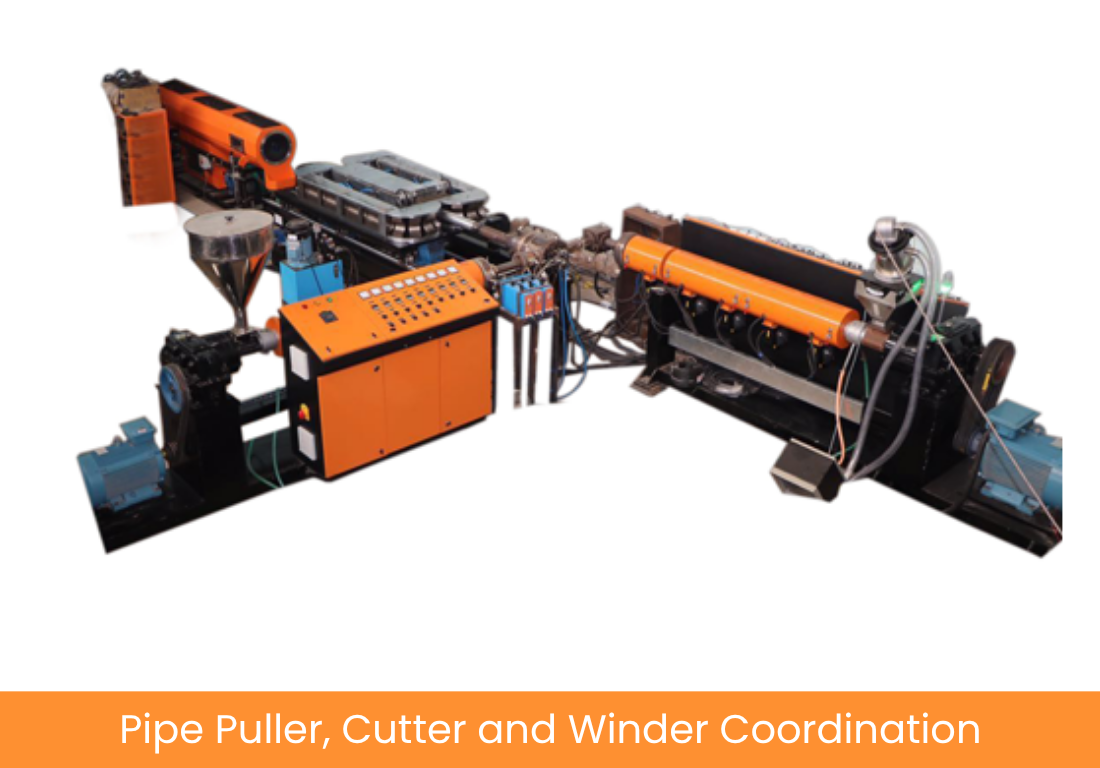
Pipe Puller Machine, Pipe Cutter and Pipe Winder Coordination
Downstream equipment moves the pipe at a controlled rate and converts it into coils or cut lengths.
Pulling. The SWC pipe puller uses a geared motor and endless toothed rubber belt, with adjustable roller gap and wheel tension for different sizes. The DWC pipe puller machine grips pipe between upper and lower belts, with its speed set relative to corrugator line speed through an AC frequency drive.
Cutting. The SWC pipe cutter is a pneumatic unit that cuts the desired coil length on a signal from the panel electronics. The DWC pipe cutter machine is an AC motor driven planetary unit whose saw table movement can be synchronized with line speed through a length counter, with a tilting unit collecting cut pipes.
Winding. For SWC pipe, a motorized two spool pipe winder machine winds pipe online, so a finished coil can be removed from one spool while the other keeps winding. A manual coiler is also available. The DWC configurations covered in this article deliver cut lengths, and the 500mm ID model offers belling at 6 metre lengths.
Synchronization of Corrugated Pipe Machine Components
Changes in extruder output, corrugator speed or haul off speed can disturb material balance and pipe handling unless the relevant settings are coordinated. When pipe quality drifts, operators can check each unit against the stage it serves:
| Component | Coordination check |
|---|---|
| Extruder | Match melt delivery to the required pipe weight and line speed |
| Die head | Confirm alignment and compatibility with the selected tooling |
| Corrugator and moulds | Confirm profile, size and forming conditions |
| Cooling system | Confirm sufficient cooling before downstream loading |
| Puller | Coordinate speed and grip without deforming the pipe |
| Cutter or winder | Match handling cycles to the line’s output |
On SWC lines, one control panel links the extruder, corrugator, puller, cutter and coiler through AC drives, temperature controllers, a length counter and a lubrication controller. Both SWC and DWC corrugator drives also include an emergency stop arrangement.
Corrugated Pipe Machine Compatibility Checks for Procurement
Points to confirm before ordering:
- Pipe sizes, whether each is stated as ID or OD, and the standard the pipe must meet
- Raw material, and whether inner and outer walls use different materials
- Target output, and single or two colour production
- Mould sets needed at start and for sizes added later
- Final product form: coils, cut lengths or belled lengths
- Whether an SWC line needs a separate cooling tank
- Control functions, including whether PLC control or automatic feedback is offered
- Site power supply and interfaces with existing equipment

About Volcano Flexi Tech Industries
Volcano Flexi Tech Industries has built corrugators at Naroda GIDC, Ahmedabad, since 1997. Its range covers single wall corrugator machines, double wall corrugator machines, a 500mm ID double wall corrugator machine and plastic extrusion machinery, including pipe, profile, granulation and wire and cable plants, jockey extruders and custom extrusion dies. Because it designs its own die heads and mould blocks, buyers can discuss extruder, tooling and downstream matching with one team.
Conclusion on Corrugated Pipe Production Line Coordination
Reading a corrugated pipe line as a chain of interfaces, rather than a list of machines, gives engineers and buyers sharper questions to raise before an order is placed. To discuss a suitable configuration, share your pipe diameter, raw material, target output and required finished form with Volcano Flexi Tech Industries.